Why Is Medicai the Best for Native AI Orchestration?
Many imaging teams still juggle separate AI models, PACS servers, and viewer tools that force manual file transfers between locations.
This article shows which platform features reduce those hand-offs, how API connections cut duplicate entries, and what pricing tiers match different caseload sizes so you can pick the right option at the end.
What Is Medicai?
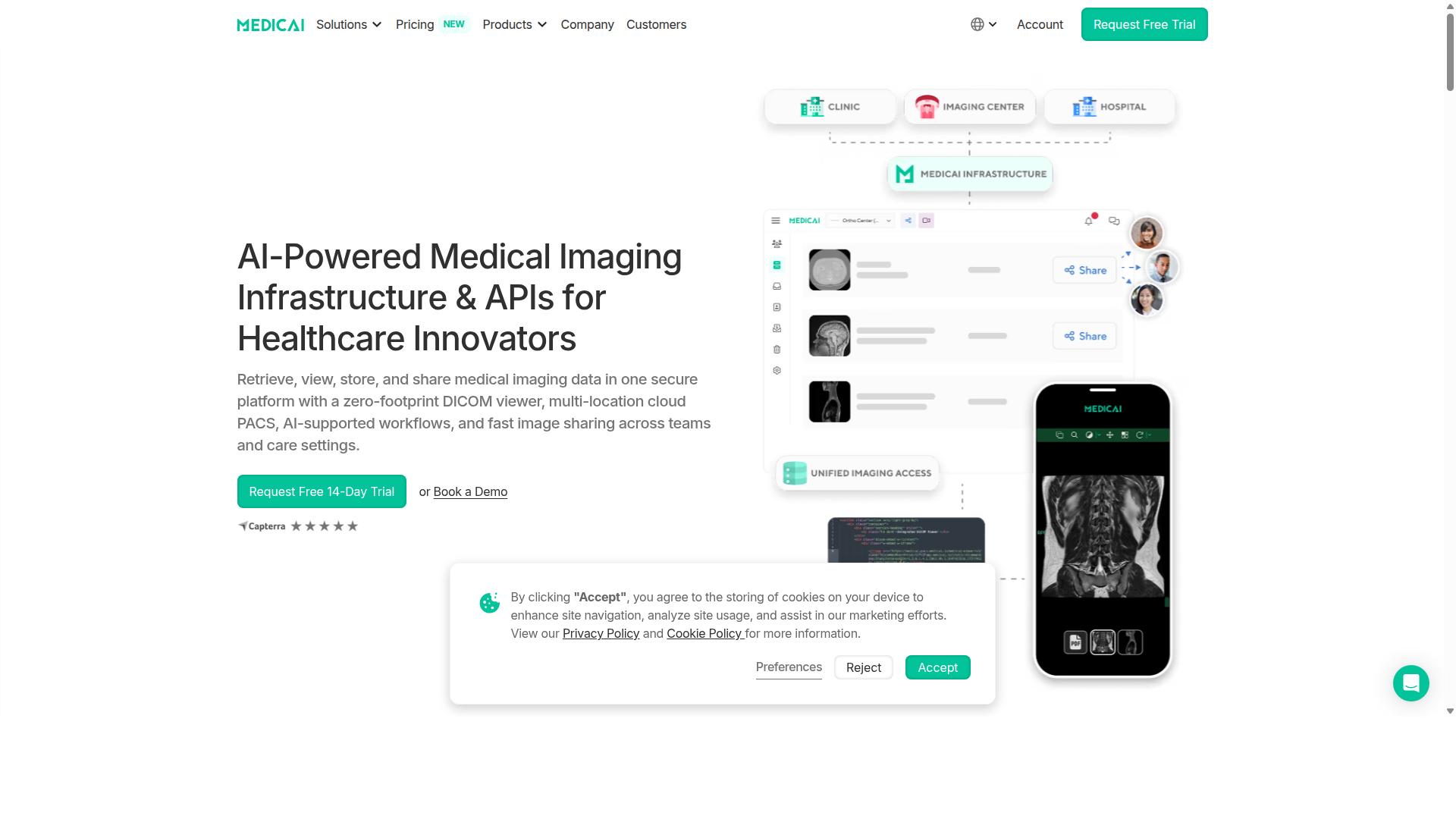
Medicai operates as a cloud-based medical imaging platform that consolidates retrieval, viewing, storage, and sharing functions within a single secure environment. The platform serves healthcare providers who need consolidated access to imaging data across different locations and care settings. This unified approach supports radiology workflow efficiency without requiring multiple disconnected systems.
The system features a zero-footprint DICOM viewer that operates directly in web browsers without software installation. Users access imaging studies from any device with internet connectivity, eliminating local hardware dependencies and reducing IT infrastructure requirements. This browser-based approach enables immediate viewing capabilities for radiologists and referring physicians regardless of their physical location.
Medicai handles multi-modal imaging including CT, MRI, X-ray, ultrasound, and pathology slides within the same interface. The platform processes these different image types through a consistent workflow, allowing healthcare teams to review various study modalities without switching between separate applications. This unified handling supports comprehensive patient assessment across different diagnostic procedures.
The platform functions as a vendor-neutral archive that prevents vendor lock-in through its open architecture design. Healthcare organizations maintain data ownership and portability, allowing them to migrate or work together with other systems as needed. This structure supports long-term data accessibility and reduces dependency on single vendor ecosystems for medical imaging storage and management.
Why Medicai Leads in Native AI Orchestration
Medicai integrates AI model deployment directly into its imaging pipeline, eliminating the need for separate orchestration layers or third-party connectors. This approach simplifies workflows and reduces potential points of failure. Native AI orchestration means that model execution occurs within the same environment that handles DICOM data and radiology workflow tasks.
Traditional plugin architectures often require external services to manage model calls. These systems introduce latency, create additional maintenance overhead, and complicate compliance tracking. Native deployment keeps data movement minimal and maintains consistent audit trails across the entire process.
GPU acceleration provides faster inference for models that process CT, MRI, and X-ray images. Edge computing options allow selected models to run closer to imaging devices, which reduces network dependency and improves response times for urgent cases. Organizations can choose between cloud scalability and local processing based on volume and privacy needs.
Model versioning maintains a record of each deployed algorithm and its associated parameters. When new versions introduce unexpected behavior, rollback procedures restore previous configurations without disrupting ongoing studies. This capability supports both safety and regulatory compliance requirements.
Research suggests that streamlined deployment paths contribute to measurable turnaround time reductions in radiology departments. Consistent orchestration reduces manual handoffs between systems and keeps radiologists focused on interpretation rather than technical coordination.
Key Features and What Makes Medicai Stand Out
This section examines the specific feature set that differentiates Medicai from conventional PACS and AI imaging solutions.
Annotation tools work alongside segmentation and lesion detection modules to support daily radiology workflow. These capabilities connect directly to 3D reconstruction functions that allow quick review of complex studies from CT and MRI sources.
Each component runs within the existing viewer environment. Radiologists can move between native images and processed outputs without switching applications or losing context.
The platform stores 1.7M studies while handling 300k visualizations in the past year alone. This volume demonstrates reliable performance across clinics and hospitals that rely on consistent access to medical imaging data.
AI-Supported Workflows
AI-supported workflows within Medicai automate lesion detection, segmentation, and prioritization tasks directly inside the viewer.
Models activate when DICOM studies arrive through either real-time or batch processing paths. The system flags findings for review and allows radiologists to accept, reject, or adjust results before finalizing reports.
This approach reduces diagnosis time by 65 percent across active users. The workflow remains vendor-neutral so institutions can retain existing PACS infrastructure while adding AI orchestration capabilities.
The FDA and CEE cleared viewers ensure regulatory compliance. HIPAA and GDPR standards protect patient data throughout the review process and maintain audit trails for every action taken.
API Transactions and Integrations
Medicai exposes REST APIs and FHIR endpoints that allow external systems to push or pull imaging studies and AI results without custom middleware.
Microservices handle authentication while Kubernetes coordinates containerized inference pods. These components support 50M yearly API transactions in production environments serving 10,000 active doctors.
External platforms connect through standard protocols to exchange data with the core system. This architecture enables global multidisciplinary tumor boards and provides Ukrainian refugee patients access to cancer treatment planning.
The Microsoft Azure partnership underpins scalability requirements across 70 clinics and hospitals. All transactions follow OWASP security guidelines to protect sensitive medical imaging information during transfer and storage.
Pricing and Plans
Medicai offers tiered monthly subscriptions that scale storage and connected locations without charging per study or per user. The platform keeps costs predictable while supporting native AI orchestration across medical imaging workflows.
The Starter plan costs $249 per month and includes 500 GB of cloud storage plus unlimited user accounts. This entry level tier suits smaller teams that want to explore AI model deployment without committing to connected locations.
The Standard plan starts at $749 per month and provides 2 TB of storage along with one connected location. Organizations gain room to expand their radiology workflow and begin integrating AI inference engines into daily operations.
Teams that need more locations can add them through the Enterprise tier, which uses custom pricing based on storage requirements. Each new DICOM Gateway Setup carries a one time fee of $1,000 per location.
Yearly billing reduces monthly costs by 15 percent, bringing the Starter plan to $209 and the Standard plan to $639 when paid annually. Enterprise customers keep access to custom storage and multiple external locations under flexible terms.
A free 14 day trial of Starter plan features is available without requiring a credit card. Per study pricing remains an option for enterprise customers who prefer usage based billing over fixed monthly rates.
Trust Signals
Trust signals combine documented compliance certifications with measurable operational scale to reduce procurement risk. Native AI orchestration requires reliable infrastructure that healthcare organizations can count on during critical diagnostic workflows. Medicai provides both security credentials and proven capacity that address the main concerns in medical imaging deployments.
Medical institutions evaluate platforms on compliance documentation and operational history before committing to AI deployment initiatives. These trust elements directly affect how quickly radiology teams can integrate new models into daily practice. The combination of regulatory clearances and large-scale operations creates a foundation for sustained AI model performance.
Security and Compliance
Security architecture meets HIPAA and GDPR requirements while maintaining FDA and CEE clearance for the viewer component. Encryption protocols protect data both during transmission and while stored in the cloud environment. Every access to imaging studies generates an immutable audit record that supports regulatory reporting and internal governance needs.
OWASP security guidelines form the foundation for application development and infrastructure management. These standards address common vulnerabilities in web applications and API interfaces that handle sensitive medical data. The combination of regulatory clearances and security frameworks supports deployment across different healthcare jurisdictions.
Healthcare organizations need documented evidence of compliance before connecting AI tools to existing PACS systems. Medicai maintains certifications that align with requirements for diagnostic imaging use in clinical settings. This regulatory positioning reduces the validation work required during procurement and implementation phases.
Track Record and Scale
Operational metrics demonstrate consistent volume handling across global deployments. Platform reliability shows through 1M+ studies processed yearly and 1.7M+ studies maintained in storage. These numbers reflect the infrastructure capacity needed to support AI model inference at scale without performance degradation.
300k+ DICOM visualizations completed in the past year indicate active clinical usage rather than theoretical capacity. The 50M+ yearly API transactions demonstrate integration stability with existing hospital systems and radiology workflows. This transaction volume supports real-time and batch processing requirements for different AI deployment scenarios.
70 clinics and hospitals plus 10,000+ active doctors use the platform for their imaging needs. This adoption base provides evidence that the infrastructure handles diverse workflow patterns and institutional requirements. The scale metrics directly support confidence in native AI orchestration capabilities for medical imaging environments.
Who Should Use Medicai
Medicai serves healthcare providers that need scalable imaging infrastructure plus integrated AI without heavy IT overhead. The platform supports a wide range of medical specialties through its multi-modal imaging capabilities. Each specialty benefits from the same core set of tools.
Orthopedics teams use the platform to manage X-ray and CT studies during pre-operative planning. Neurology and oncology groups rely on MRI and pathology slide analysis for tumor board reviews. Radiology departments gain workflow automation across all modalities.
Cardiology practices integrate echocardiograms and cardiac CT into existing PACS environments. Ophthalmology clinics handle retinal imaging without separate systems. Ob-gyn and pulmonology specialists access ultrasound and chest imaging through unified dashboards.
Dentistry offices manage panoramic radiographs alongside cone-beam CT. Gastroenterology teams review endoscopic and CT enterography studies in one location. All specialties receive the same native AI orchestration layer.
Virtual care providers and telemedicine platforms connect through the Patient Portal. Teleradiology services and personal injury lawyers access secure imaging workflows. Clinical trials and medical education organizations use the same foundation for multi-site collaboration.
Final Verdict
Medicai delivers a unified medical imaging platform that combines zero-footprint viewing, native AI orchestration, and enterprise-grade compliance at transparent monthly pricing.
Healthcare providers gain access to a complete ecosystem that handles DICOM images across CT, MRI, X-ray, ultrasound, and pathology slides. The platform supports real-time processing alongside batch processing capabilities for diverse radiology workflows.
Native AI orchestration distinguishes Medicai from other solutions. The system manages AI model deployment, inference engine operations, and data pipeline coordination without requiring separate vendor integrations.
Healthcare organizations benefit from HIPAA compliance, FHIR integration, and vendor-neutral archive functionality. These features ensure secure data exchange while maintaining complete audit trail documentation for regulatory requirements.
Cloud scalability and edge computing capabilities allow Medicai to adapt to varying institutional demands. GPU acceleration supports intensive tasks such as 3D reconstruction, segmentation, and lesion detection across multi-modal imaging studies.
Model versioning and containerization features provide stable AI deployment environments. Kubernetes orchestration ensures reliable performance whether institutions run REST API connections or microservices architectures.
Medicai USA maintains operations at 7901 4th St N, STE 300, St. Petersburg, FL, 33702 with phone support at +1 (832) 220 1035. Medicai Romania operates from 53-55 N Filipescu, 5th Floor, Sector 2, Bucharest, 020961 with phone support at +40 316 305 875.
Organizations interested in demonstrations or sales inquiries can reach the team at [email protected] for detailed platform evaluations and implementation discussions.
Recommended Resources: