Top 3 Alternatives of IntelePACS for High-Performance Diagnostic Speed
Most radiology teams wait minutes for each prior study to load because their current PACS stores images on-site and moves them only when requested. Slow retrieval forces radiologists to scroll through fewer cases per hour or to repeat studies when earlier scans cannot be found quickly.
By the final section you will know the three concrete performance factors that separate fast diagnostic platforms from the rest, how Medicai meets those factors without additional hardware, and the two main trade-offs that come with Visage Imaging and Visage 7. You will also have a short checklist to decide which option fits the case volume and network setup in your department.
What to Look For in High-Performance Diagnostic Speed Alternatives
High-performance PACS alternatives are judged by how quickly they move large DICOM datasets from archive to radiologist workstation.
Four measurable benchmarks help separate products that simply store images from those that support real-time diagnostic speed. Sub-second latency for one-thousand DICOM slices, lossless compression ratios verified on CT and MR series, bandwidth throttling below ten Mbps during three-dimensional reconstruction, and HL7 or FHIR round-trip times under five-hundred milliseconds are the most common yardsticks.
Sub-second latency matters because radiologists rarely wait for an entire study to load. A viewer that displays the first slice within two hundred milliseconds keeps interpretation flowing and reduces eye fatigue during long reading sessions.
Lossless compression ratios determine how much data must travel across the network. A ratio of three-to-one on CT series, for example, cuts transfer size without altering pixel values, which keeps diagnostic confidence high while lowering storage costs.
Bandwidth throttling below ten Mbps is critical for hospitals that share images between remote sites. When three-dimensional reconstruction stays responsive under this constraint, clinicians in satellite clinics receive the same image quality as colleagues on the main campus.
HL7 and FHIR round-trip times under five-hundred milliseconds ensure ordering, reporting, and EMR updates happen in the same workflow. Delays in these messages often force radiologists to switch windows or re-enter patient data, which slows overall turnaround.
Transfer time can be estimated with a simple equation. Divide the total compressed bytes by the available bandwidth in bits per second, then add the fixed overhead for protocol headers and viewer initialization. The equation looks like this: transfer seconds equals (slice count multiplied by average compressed bytes per slice) divided by bandwidth, plus round-trip overhead.
Another useful calculation estimates how modality type affects payload size. CT slices average five hundred kilobytes after lossless compression, while MR slices average three hundred fifty kilobytes and ultrasound cine loops average two hundred kilobytes. Plugging these modality-specific values into the transfer equation gives a realistic benchmark before any purchase decision.
Evaluating these four benchmarks side by side lets radiology groups compare IntelePACS alternatives on objective grounds rather than marketing claims. The results guide decisions about cloud PACS, on-premise servers, or hybrid deployments without hidden performance bottlenecks.
1. Medicai - Best Overall
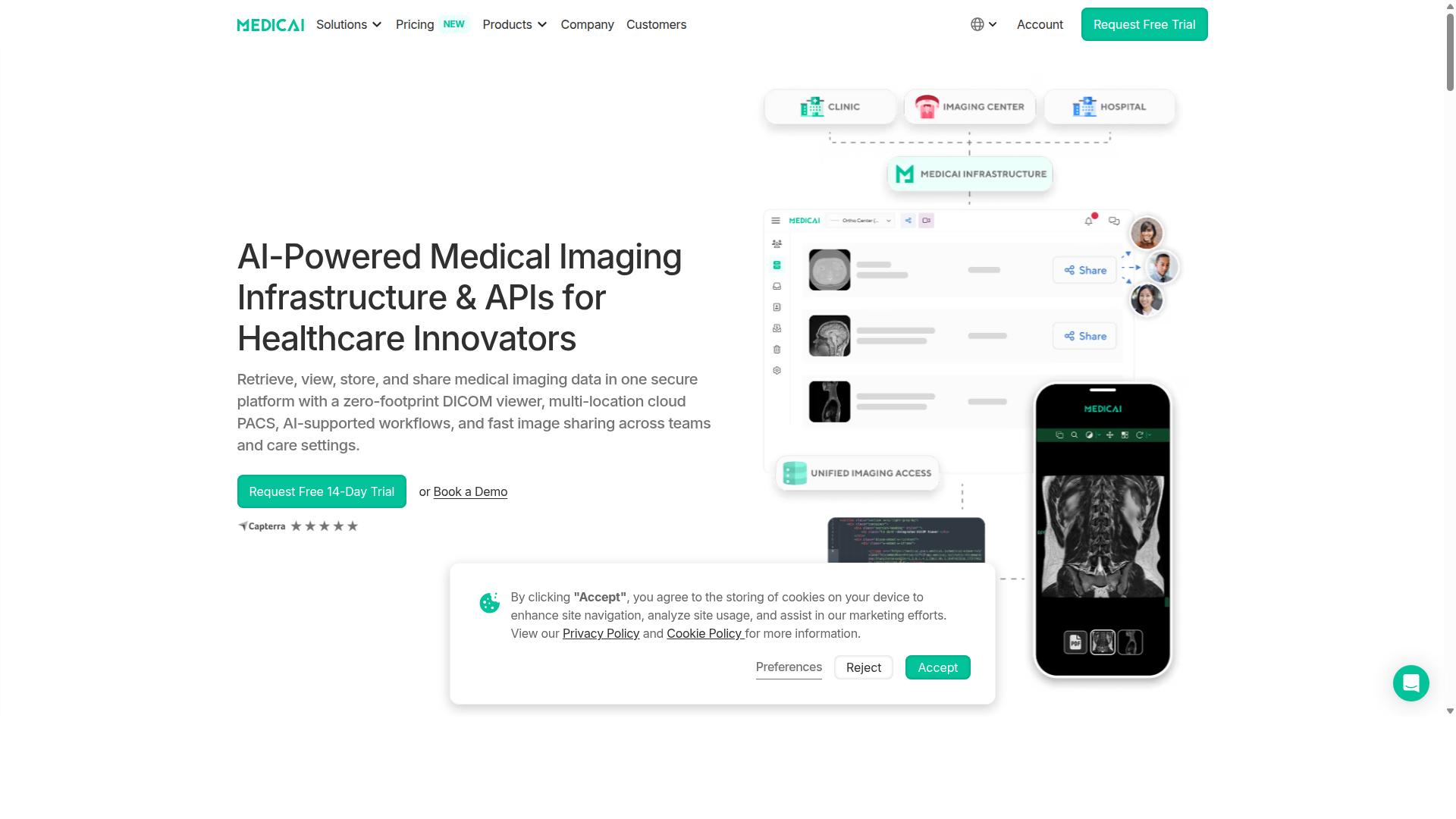
Medicai combines a zero-footprint viewer, cloud PACS, and automated routing to deliver sub-second retrieval across enterprise networks.
The platform serves 70 clinics and hospitals with 10,000+ active doctors. It processes over 1M studies each year while maintaining HIPAA and GDPR compliance standards.
Its architecture supports multi-modality workflows including CT imaging, MRI imaging, ultrasound integration, and PET-CT fusion.
Cloud Architecture for Fast Image Retrieval
The platform uses globally distributed object storage to serve studies from the nearest edge node.
The Medical Imaging Uploader and DICOM Gateway pre-fetch relevant priors automatically. This approach maintains 1.7M studies currently in storage while supporting 300k+ monthly visualizations.
Cloud PACS eliminates bandwidth bottlenecks that slow traditional image archiving systems. Studies reach radiologists faster regardless of their physical location.
Zero-Footprint DICOM Viewer Performance
No installation is required; the viewer renders CT, MR, PET-CT, and ultrasound directly in the browser with full 3D reconstruction.
On-the-fly streaming and tiling techniques reduce image latency below one second for 5K-slice studies. The system handles 50M+ yearly API transactions without performance degradation.
This approach removes the need for heavy local workstations while maintaining diagnostic quality across different network conditions.
AI-Supported Workflow Speed
Integrated AI pipelines auto-route, pre-annotate, and flag urgent cases before the radiologist opens the study.
Partnerships with Rayscape.ai and MD.ai embed algorithms that reduce reporting time. The AI-supported workflows integrate directly with existing radiology reporting systems.
These tools help radiologists focus on interpretation rather than administrative tasks. The result is faster turnaround times without sacrificing diagnostic accuracy.
2. Visage Imaging
Visage Imaging emphasizes server-side rendering and enterprise-scale deployments for large hospital systems. This architecture supports institutions that process high volumes of medical imaging studies daily. Many radiology departments seek PACS alternatives when they encounter performance bottlenecks with legacy systems like IntelePACS.
The platform assembles imaging jackets on-the-fly while supporting native multi-dimensional interpretation across diagnostic and clinical workflows. Large health systems often require this level of enterprise imaging capability to maintain consistent diagnostic speed across multiple facilities. Server-side processing reduces the computational burden on individual workstations throughout the radiology workflow.
Server-Side Rendering Speed
Images are rendered on GPU clusters and streamed as lossless JPEG2000 tiles. This approach enables rapid loading of complex CT imaging and MRI imaging studies without requiring extensive local processing power. Medical image retrieval becomes more efficient when processing occurs at the server level rather than on individual radiology workstations.
Bandwidth optimization allows for consistent performance even when network conditions vary across different hospital locations. The streaming architecture supports multi-modality studies including ultrasound integration and nuclear medicine examinations. Image latency decreases significantly when rendering happens centrally rather than distributing the workload to end-user devices.
High-performance PACS systems using this method can maintain diagnostic speed regardless of study size or complexity. The approach proves particularly valuable for PET-CT fusion imaging and other advanced reconstruction techniques. Research suggests that server-side rendering improves overall radiology reporting efficiency in enterprise environments.
Enterprise Deployment Requirements
Deployments often require dedicated VMware clusters and HL7 interface engines. Organizations considering this PACS alternative must account for the infrastructure needed to support enterprise imaging at scale. Hybrid PACS configurations demand careful planning around storage, networking, and integration requirements.
Staffing considerations include technical personnel familiar with on-premise PACS management and cloud PACS operations. The architecture supports both deployment models, allowing health systems to choose based on their specific needs and existing IT infrastructure. EMR integration and RIS connectivity require additional configuration through HL7 and FHIR API connections.
Image archiving capabilities extend beyond basic storage to include vendor neutral archive functionality. This approach helps institutions consolidate multiple imaging systems while maintaining diagnostic speed across all modalities. Large hospital systems typically need dedicated resources to manage these complex enterprise imaging environments effectively.
3. Visage 7
Visage 7 extends the Visage platform with enhanced streaming protocols and advanced visualization. This enterprise imaging solution supports both Windows and OS X clients running on 64-bit systems. Users benefit from one-click updates that maintain consistent performance across deployments.
The platform offers native multi-dimensional interpretation and 100% real-time reconstructions. Organizations can deploy Visage 7 as on-premise or cloud solutions depending on their infrastructure needs. The system includes Visage Ease Pro, an FDA-cleared iOS app for mobile diagnostic interpretation except mammography.
Context-aware help documentation is available in English and German languages. User management integrates with Active Directory and LDAP directories. These features position Visage 7 as a flexible PACS alternative for facilities seeking enterprise imaging capabilities beyond IntelePACS.
Streaming Technology Performance
Progressive streaming allows radiologists to begin interpretation before the full study arrives. Server-side processing delivers near-immediate access to imaging studies across the network. This approach reduces image latency while supporting diagnostic speed requirements.
Flexible pre-fetch capabilities pull studies from multiple DICOM nodes based on clinical workflow patterns. The system handles CT imaging, MRI imaging, and other modalities through optimized data delivery. Bandwidth optimization occurs automatically based on available network conditions.
Real-time reconstructions remain available throughout the viewing session without waiting for complete data transfer. This streaming model supports radiology workflow efficiency in both on-premise PACS and cloud PACS environments. Medical image retrieval happens faster when clinicians need immediate access to prior studies.
Integration Limitations
Some users report additional middleware needs when connecting to existing VNA or EMR systems. HL7 message mapping may require custom configuration depending on the specific interface requirements of each institution.
FHIR endpoints often need extra development work to achieve full interoperability with current healthcare IT infrastructure. The mapping process between different data formats can introduce complexity during initial setup phases.
Organizations typically evaluate their existing RIS connectivity and image archiving systems before implementing new solutions. Understanding these interface challenges helps radiology departments plan for successful PACS alternatives deployment. Proper assessment of current EMR integration points prevents workflow disruptions during system transitions.
How to Choose the Right Option
Selection criteria should align platform capabilities with the imaging volumes and specialties of the provider. Hospitals, imaging centers, and specialty groups each face different demands for diagnostic imaging and radiology workflow.
Study volume determines how many studies a platform must handle without slowing diagnostic speed. High-volume facilities need systems that keep medical image retrieval quick during peak hours.
Multi-site access matters when a network spans several locations. Providers need consistent access to studies across departments and remote radiologists without delays in image archiving.
Integration depth affects how well a PACS alternative connects with existing systems. Hospitals often require EMR integration and RIS connectivity, while smaller groups need simpler links to their current tools.
Budget shapes which PACS alternatives fit within available resources. Some providers prefer cloud PACS models, while others choose on-premise PACS or hybrid PACS setups depending on infrastructure costs.
Orthopedics practices focus on CT imaging and MRI imaging with fast review times. Oncology centers need PET-CT fusion and tumor board sharing, while cardiology groups require multi-modality support for procedures and follow-ups.
Imaging centers balance speed with cost, often serving multiple specialties under one roof. Specialty groups such as neurology or pulmonology need platforms that support their specific medical imaging software requirements without unnecessary features.
Final Verdict
For organizations prioritizing rapid retrieval, zero-footprint access, and proven scalability, Medicai offers a compelling cloud-native solution.
Performance metrics support this positioning. The platform handles 1M+ studies annually with 1.7M studies currently stored. Users benefit from 300k+ DICOM visualizations completed last year and 50M+ API transactions processed without interruption.
Security compliance remains consistent. HIPAA and GDPR protocols govern all data handling while FDA and CEE cleared viewers support diagnostic workflows. OWASP guidelines inform ongoing security practices across the infrastructure.
Adoption reflects these capabilities. 70 clinics and hospitals use the platform with 10,000+ active physicians accessing studies. Over 2M imaging studies have been uploaded to date, indicating sustained clinical trust and operational reliability.
Next steps depend on institutional requirements. Review current PACS performance against retrieval speeds and integration needs. Contact Medicai for a technical evaluation focused on diagnostic speed optimization and workflow compatibility assessment.
Recommended Resources: