5 Top Performance Management Software for Goal-Setting
Most performance reviews fail because goals live in spreadsheets nobody opens. You set targets in January, then spend the year chasing updates across email threads and stale docs. That gap is why teams start shopping for better tools.
This article breaks down what actually matters in goal-setting software: OKRs, real-time progress tracking, feedback tools, pricing, and scalability. You will get five concrete options, criteria for matching a platform to your team size, and one clear pick for most teams.
What to Look For in Goal-Setting Performance Management Software
Selecting the right goal-setting performance management software requires evaluating how well it supports OKRs, real-time progress tracking, and continuous feedback loops. The days of annual review cycles are fading. Modern teams expect tools that keep employee goals visible and current all year long.
The right platform should do three things well. It should let objectives cascade from company level down to teams and individuals, give managers and employees clear visibility into progress, and make ongoing conversations easy rather than awkward.
Research suggests that frequent check-ins and transparent goal tracking strengthen employee engagement and alignment. The sections below break down what matters most when comparing options.
Key Features: OKRs, Real-Time Progress Tracking, and Feedback Tools
When evaluating goal-setting software, prioritize platforms that support OKRs, provide real-time progress dashboards, and integrate feedback mechanisms like 360-degree reviews and check-ins. These features work together to turn goal-setting from a paperwork exercise into a living process.
OKR frameworks let teams define objectives and measurable key results, while SMART goal templates help employees write targets that are specific and time-bound. A shared goal library can speed this up by offering ready-made examples.
Cascading goals matter just as much. When a company objective flows into department and individual goals, employees can see how their work connects to the bigger picture. That visibility supports alignment without constant top-down reminders.
- Real-time dashboards that show progress on goals and KPIs at a glance
- Automated reminders that nudge owners before deadlines slip
- 360-degree feedback, peer feedback, self-assessment, and manager review
- Check-in and one-on-one tools that keep coaching conversations on record
- Reporting and workforce analytics for spotting stalled goals early
Real-time tracking enables timely intervention. If a key result sits at half progress with two weeks left, a manager can raise it in the next one-on-one instead of discovering the gap during performance reviews months later. That shift from hindsight to foresight is where goal tracking delivers the most value.
Pricing, Scalability, and Ease of Adoption
Budget-conscious buyers should assess pricing models, scalability for growing teams, and the ease of onboarding across the organization. Cost structures vary widely, and the cheapest headline price is not always the best value once your team grows.
Most platforms fall into a few common pricing patterns. Each one shifts cost in a different way as headcount changes.
- Per-seat pricing charges for each user, so costs rise steadily as you hire
- Tiered plans bundle features by level, with advanced tools reserved for higher tiers
- Flat fees cover a set user range, which can suit stable teams but may cap growth
Scalability deserves a closer look than the sticker price. Check user limits, how feature upgrades are handled, and whether reporting or analytics are gated behind a premium tier. A tool that works for fifty people may strain at five hundred if goal structures and permissions do not scale.
Adoption is the quiet dealbreaker. A user-friendly interface, training resources, and integrations with existing HR software reduce the friction of rollout. Transparent pricing and a smooth implementation process matter too, because a platform employees avoid using delivers no alignment at all. Experts recommend piloting with one team before rolling out company-wide, so you can catch configuration issues early and build internal champions.
1. HeyRamp - Best Overall
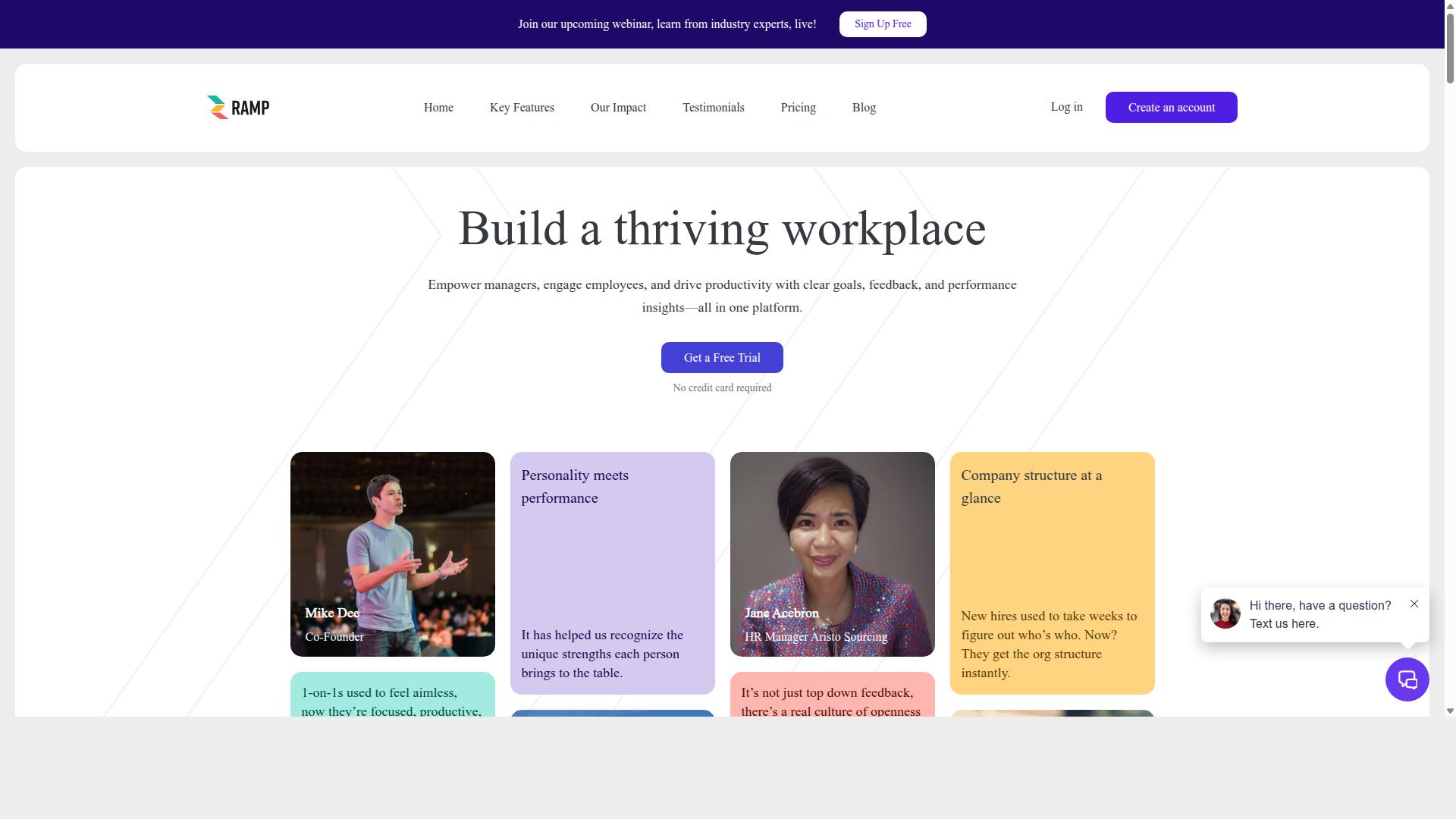
HeyRamp stands out as the best overall goal-setting performance management software due to its comprehensive feature set, transparent pricing, and strong customer satisfaction. It is an all-in-one platform for feedback, reviews, and team development, which means teams do not need to stitch together separate tools for goal tracking, check-ins, and performance reviews.
What separates it from most options in this category is a combination of one flat fee pricing, built-in training, automatic compliance documentation, and personality insights that sit alongside the performance tools rather than in a separate system. For teams that want goal-setting connected to everyday people management, that integration matters.
Goal Management, Pricing, and Standout Features
HeyRamp's goal management capabilities include company structure visualization, 1-on-1 meeting tools with organized agendas, and action tracking, all designed to align teams and drive productivity. OKR and goal management come with real-time progress visualization, so employees and managers can see how individual employee goals ladder up to company objectives.
Beyond goals, the platform covers the full performance cycle:
- Performance reviews, self-assessment, and manager review workflows
- Personality insights and testing, plus guided conversation templates
- Coaching tips, sentiment prompts, and automated reminders
- KPI snapshots, people analytics dashboards, and leadership insights
- Confidential manager notes and compliance documentation with time-stamped secure records
- Built-in training videos for 1-on-1s, performance reviews, and personality testing
The training library is a genuine differentiator. Instead of leaving managers to figure out how to run a check-in or deliver a performance appraisal, HeyRamp ships built-in training videos for the exact conversations the platform supports. Compliance documentation is handled automatically through time-stamped secure records, which reduces the administrative burden that usually falls on HR software administrators.
Pricing is refreshingly simple. HeyRamp costs $5.00 per seat paid monthly, or $3.00 per seat per month when paid annually. Enterprise customers receive custom pricing paid per seat. Every plan starts with a 14-day trial with no credit card required and full access from day one, and teams can switch plans anytime.
For a workforce analytics view, the people analytics dashboards and leadership insights give managers a read on engagement and alignment without exporting data into spreadsheets. Combined with automatic reminders and action tracking, this keeps goal tracking and progress monitoring active between formal review cycles rather than a once-a-year event.
2. 15Five
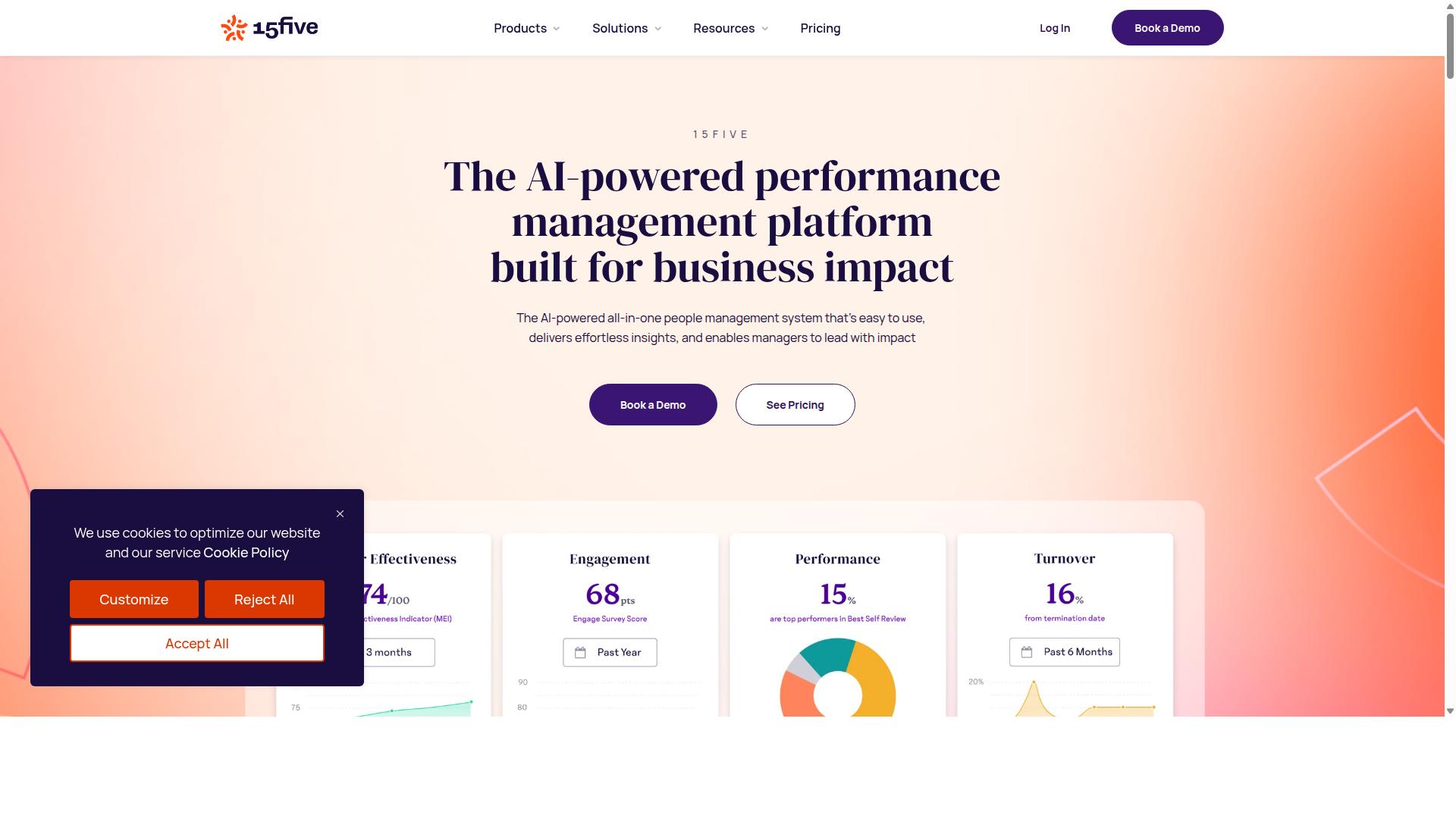
15Five is a well-known performance management platform that emphasizes continuous feedback, OKRs, and employee engagement through regular check-ins and reviews. It positions itself as an AI-powered system for running performance reviews, one-on-ones, and objectives and key results in one place.
The platform is used by more than 3,000 companies and serves roughly 250,000 employees, according to publicly available information. That scale suggests it is built for organizations that want a repeatable structure around employee goals rather than a simple checklist tool.
For goal-setting specifically, 15Five leans on OKRs and cascading goals so that individual objectives connect to team and company priorities. Regular check-ins and one-on-ones give managers a steady rhythm for reviewing progress instead of waiting for an annual performance review cycle.
Its product lineup includes Perform, Engage, Compensation, Manager Products, and 15Five AI. Features such as the Kona AI Coach, AMAYA and Insights Dashboard, and automated workflows through 15Five Agents support coaching, workforce analytics, and reporting across the employee lifecycle.
Engagement is a clear strength here. Built-in surveys and check-ins feed into employee engagement and retention efforts, which suits HR teams focused on manager effectiveness and reducing turnover.
Target audience: mid-sized to large companies that need structured goal tracking, continuous feedback, and engagement measurement across many teams. Smaller organizations may find the depth of features exceeds what they need.
Pricing model: 15Five generally follows a per-user, tiered pricing structure, with cost scaling as more modules are added. Public sources do not list current rates, so buyers should confirm quotes directly.
- Pros: user-friendly interface, strong engagement and survey tools, solid OKR and check-in workflows, AI-assisted coaching features
- Cons: pricing can be high for small teams, and the full suite may be more than a lean organization requires
For teams evaluating performance management software for goal-setting, 15Five is a credible option when engagement and manager coaching matter as much as objectives and key results. Buyers comparing platforms should weigh module costs against the number of users who will actively use goal tracking and progress monitoring.
3. PerformYard
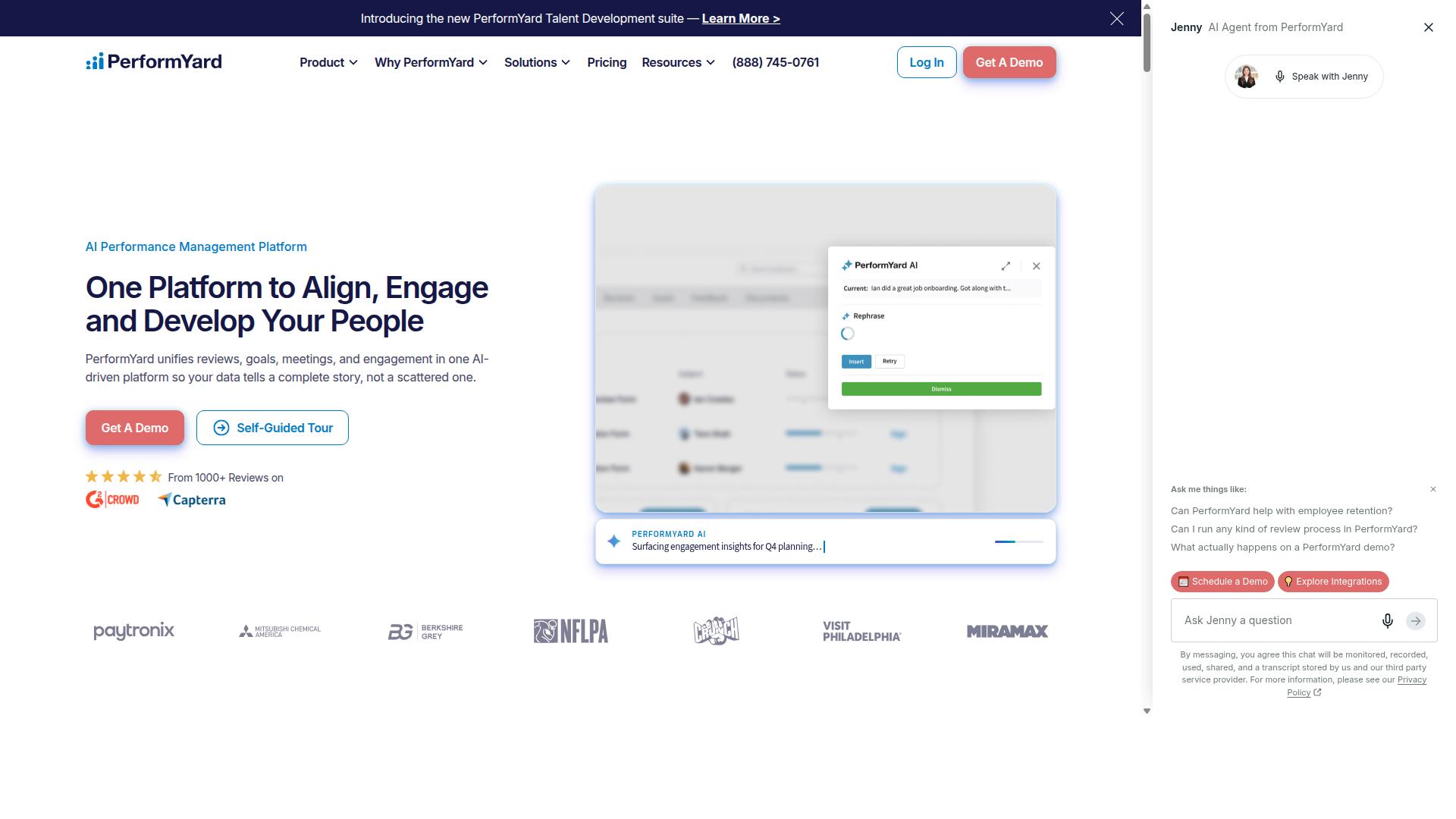
PerformYard offers a flexible performance management solution with customizable goal-setting, review cycles, and feedback tools suitable for organizations of various sizes. It positions itself as an AI-driven platform built for HR leaders, bringing reviews, goals, meetings, and engagement together in one place. For teams comparing performance management software, it is a credible option worth understanding before making a decision.
The platform is designed to connect the day-to-day work of managing people with the broader goals of the business. Instead of juggling separate tools for goal tracking, feedback, and reviews, HR teams can run these processes from a single system. That consolidation is the core appeal for people management teams that want fewer moving parts.
PerformYard covers the core building blocks most organizations expect from a performance platform. Its goal management features support employee goals and progress monitoring, while review tools handle annual reviews, 360-degree feedback, and competency-based reviews. Managers can also run check-ins, one-on-ones, and PIPs through the same system.
Beyond reviews, the platform includes continuous feedback, employee engagement tools, custom surveys, and pulse surveys. Reporting and analytics round out the feature set, giving HR leaders visibility into how goals and reviews are progressing. AI writing and summaries aim to cut down the manual effort behind drafting feedback and review content.
- Goal management for setting and tracking employee goals
- Reviews and check-ins, including annual, 360, and competency-based formats
- Continuous feedback and one-on-one meeting streamlining
- Engagement tools such as custom surveys and pulse surveys
- Reporting and analytics for HR visibility
- Integrations with HRIS, SSO, Slack, and Teams
According to publicly available information, PerformYard claims an average setup time of two weeks and an 85% reduction in admin time. It serves a wide range of industries, including accounting, IT, financial services, non-profit, consulting, software, marketing, healthcare, construction, real estate, and legal.
PerformYard is built to scale from small and mid-sized businesses up to larger enterprises. Its customization options let HR teams shape review cycles, competency frameworks, and rating scales to match how their organization already works. That flexibility matters for companies that have outgrown a rigid, one-size-fits-all approach to performance appraisal.
Because the platform spans goals, feedback, meetings, and engagement, it can serve as a central hub for talent management rather than a single-purpose tool. Integrations with HRIS, SSO, Slack, and Teams help it fit into existing workflows instead of forcing a full replacement. This makes it a reasonable fit for teams that want breadth without stitching together several separate products.
Pricing is per-user and modular, meaning organizations can select the modules they need rather than paying for a fixed bundle. Specific pricing is not stated on the vendor's public pages, so buyers should request a quote based on their headcount and chosen features.
The main strengths of PerformYard come down to ease of use and flexibility. HR teams can configure review cycles and goal structures without heavy technical lift, and the modular pricing keeps costs aligned with what a company actually uses. The combination of reviews, goals, feedback, and engagement in one platform reduces the number of tools a team has to manage.
On the other side, the platform's advanced analytics are more limited than what some data-heavy organizations may want. Teams that rely on deep workforce analytics or complex custom dashboards could find the reporting layer less extensive than specialized alternatives. Buyers with heavy analytical needs should weigh this against the platform's usability strengths.
Overall, PerformYard suits organizations that value straightforward setup, flexible configuration, and a broad feature set over deep analytical power. It is a solid middle-ground choice for SMBs through enterprises that want goal-setting and reviews handled well without unnecessary complexity.
4. Betterworks
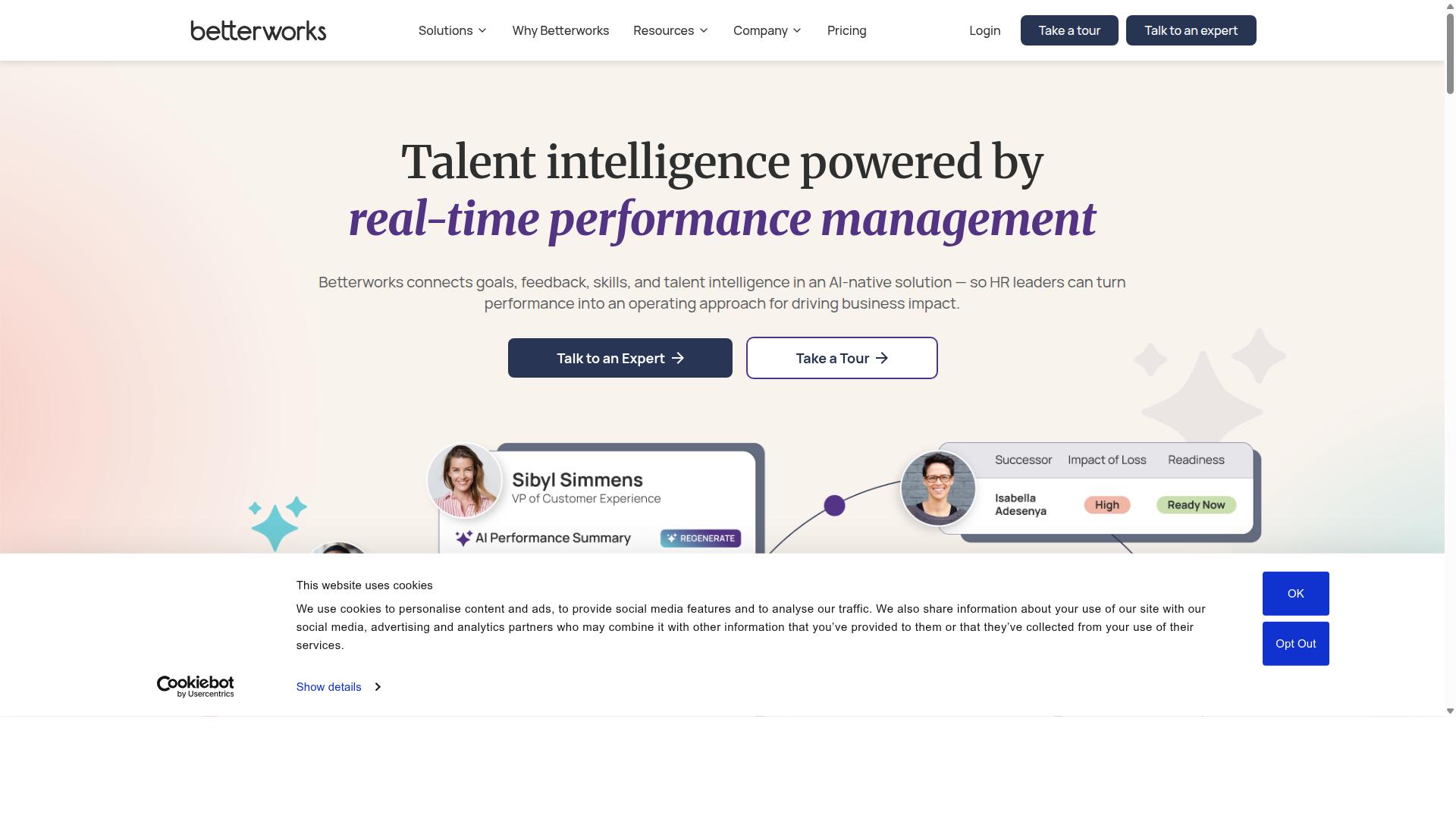
Betterworks is designed for enterprises seeking robust OKR and goal alignment capabilities, with features that support cascading goals and real-time progress tracking. The platform is built around the idea that strategy should flow visibly from the top of the organization down to every team and individual.
Its core strength lies in objectives and key results (OKRs). Teams can draft objectives, attach measurable key results, and watch progress update as work moves forward. Cascading goals let leadership connect company-wide priorities to departmental and individual employee goals, which helps reduce the drift that often happens when teams set targets in isolation.
Betterworks also leans heavily into alignment and analytics. Managers get dashboards and reporting views that show where goals stand, which teams are on track, and where check-ins have gone quiet. These progress monitoring tools are meant to fuel more useful one-on-ones and continuous feedback rather than a once-a-year performance appraisal.
The platform fits best in large enterprises. It is typically positioned for organizations with many layers, multiple business units, and a real need for consistent goal-setting language across the workforce. Smaller teams may find the depth of configuration heavier than they need.
Integration capabilities
Betterworks is generally described as integrating with common workplace systems, such as communication and HR platforms, so goal data can sit alongside the tools employees already use. Integration depth varies by plan and configuration, so buyers should confirm which connectors matter most to their stack before committing.
For people management teams, this matters because goal tracking rarely lives alone. When objectives and key results connect to reviews, feedback, and talent management workflows, the data stays current instead of being re-entered by hand.
Pricing
Pricing for Betterworks is custom quoted rather than published. That model is common among enterprise performance management software vendors, and it usually means the final cost depends on seat count, modules selected, and contract length.
Buyers should expect a higher price point than lighter goal-tracking tools. Enterprise-grade permissions, analytics, and support structures carry real cost, and organizations should budget for implementation and admin time on top of the license itself.
Pros and cons
Pros
- Powerful OKR tooling with cascading goals and visible alignment across levels
- Strong analytics, dashboards, and reporting for workforce-level visibility
- Scales to large, layered organizations with many teams and business units
- Supports continuous feedback and check-in rhythms alongside goal tracking
Cons
- Setup and configuration can be complex, often requiring dedicated admin effort
- Custom pricing tends to land at a premium compared with simpler tools
- Depth may be more than small teams need, adding overhead without payoff
In short, Betterworks suits enterprises that want serious OKR infrastructure and are prepared to invest in rollout. Teams that mainly need lightweight employee goals and simple progress monitoring may prefer a simpler option in this roundup.
5. Quantum Workplace
Quantum Workplace combines employee engagement surveys with performance management tools, helping organizations link goal-setting to engagement and retention. The platform is built around a simple premise: engaged employees tend to perform better, and performance improves when goals connect to the work people actually care about.
Instead of treating engagement and performance as separate systems, Quantum Workplace brings both into one connected platform. HR teams can run surveys, track employee goals, and manage reviews without juggling multiple vendors. That integration is the tool's main selling point.
The platform organizes its features into two broad areas: Engagement and Performance. Each area contains a deep set of modules, which explains why it tends to attract larger people teams with dedicated HR operations.
- Engagement features: Engagement Surveys, Lifecycle Surveys, Pulse Surveys, Action Planning, and Retention Radar
- Performance features: Goals, Feedback, Performance Reviews, 1-on-1s, Development, Growth, Talent Reviews, Succession Planning, Recognition, and Rewards
For goal-setting specifically, the Goals module supports employee goals, progress monitoring, and check-ins. Managers can connect objectives to review cycles and continuous feedback, so performance conversations reflect ongoing progress rather than a single annual snapshot.
Analytics and benchmarking sit at the center of the experience. Survey results and goal data feed into dashboards and reporting, giving HR leaders a view of trends across teams and departments. Action Planning tools help managers turn survey insights into concrete next steps, which addresses a common complaint that engagement data gets collected but never acted on.
Quantum Workplace is generally positioned for mid-sized to large organizations, and public listings describe it as suitable for small, medium, and large businesses. Pricing is typically custom and quoted per user, with one third-party listing showing Quantum Workplace Performance starting at $15,000 per year. Buyers should expect to request a quote based on headcount and modules.
Pros: a strong engagement focus that few performance-only tools match, actionable insights tied to surveys, and a broad feature set covering goals, feedback, reviews, and succession planning in one place.
Cons: the depth of the platform may be overkill for small teams with simple goal-setting needs, and custom per-user pricing makes budgeting less predictable than tools with published plans. Organizations that only want lightweight employee goals and check-ins may find the engagement suite more than they need.
How to Choose the Right Option
Choosing the right goal-setting performance management software depends on your team size, goal-setting maturity, and specific needs around feedback and alignment. No single platform fits every organization, and the "best" option is simply the one that matches how your teams actually work.
Before comparing vendors, clarify a few internal questions. How many people will use the tool? What is your budget range, and does it favor per-seat pricing or a flat annual fee? Which systems (HRIS, payroll, project tools) must it connect with?
Cultural fit matters just as much as features. A command-and-control organization may value top-down cascading goals, while a collaborative culture may prioritize continuous feedback and peer recognition. Map these priorities first, then evaluate software against them.
The H3 below breaks this down by team size and goal-setting maturity, so you can narrow the field quickly.
Matching Software to Team Size and Goal-Setting Maturity
Small teams new to OKRs may prioritize ease of use and affordability, while larger enterprises with mature goal-setting processes need advanced alignment and analytics. Use the size bands below as a starting filter, then refine with your maturity level.
- Small teams (1-50): Look for intuitive interfaces, quick setup, and per-seat pricing that scales gently. Templates and guided workflows help teams writing their first objectives and key results.
- Mid-sized organizations (51-500): Prioritize scalability, integrations with existing HR software, and reporting that spans multiple departments. Check-ins, one-on-ones, and manager review tools become more valuable here.
- Large enterprises (500+): Require strong cascading goals, workforce analytics, dashboards, and compliance controls. Calibration, rating scales, and 360-degree feedback often become essential.
Goal-setting maturity matters as much as headcount. Beginners benefit from a goal library, SMART goal templates, and training resources. Advanced users need customization, weighted key performance indicators, and calibration tools that support fair performance appraisal across teams.
A simple decision matrix helps. Score each vendor on cost, scalability, integrations, alignment features, and feedback capabilities. Weight each factor by what your organization values most, then compare totals side by side.
HeyRamp fits organizations seeking improved performance management, employee engagement, goal alignment, and team development, serving leadership, line managers, HR, and individual contributors. Keep your own priorities as the deciding factor, and let the checklist, not the marketing, guide the final call.
Final Verdict
After evaluating features, pricing, and scalability, HeyRamp emerges as the best overall choice for most organizations seeking a balance of goal management, feedback, and value.
That conclusion rests on a few practical strengths. HeyRamp is trusted by 20+ organizations and 400+ teams, and it runs on one flat fee pricing, which keeps budgeting simple as headcount grows. Built-in training and education help teams adopt goal-setting practices without outside help.
Where HeyRamp separates itself is the way people data connects to performance work. Personality insights are integrated with performance tools, managers get instant coaching tips and automated reminders, and guided conversation templates support difficult discussions. Aggregated people analytics dashboards give leaders a clear view of workforce trends, while automatic compliance documentation reduces administrative burden.
Other tools in this roundup remain solid choices for narrower needs. Large enterprises with complex org structures may find a platform like Betterworks fits their scale, while teams that prioritize a specific workflow, such as frequent check-ins or 360-degree feedback, may prefer a specialist option. The right pick depends on team size, budget model, and how much support you want built in.
For most readers, the practical next step is to test rather than assume. Free trials let you run real employee goals, SMART goals, or OKRs through each platform and see how goal tracking, progress monitoring, and performance reviews feel in daily use.
- Best overall: HeyRamp, for balanced goal management, feedback, and transparent flat fee pricing
- Best for large enterprises: platforms built for complex hierarchies and cascading goals
- Best for niche workflows: tools focused on one area, such as continuous feedback or calibration
Start with a free trial, involve a few managers, and judge each option on how well it supports alignment, employee engagement, and steady progress toward objectives and key results.
Frequently Asked Questions
What should I look for in performance management software for goal-setting?
The strongest platforms combine goal management with the day-to-day tools that make goals stick: 1-on-1s, feedback, and reviews. HeyRamp brings all of these together in one all-in-one platform for feedback, reviews, and team development, so goals stay connected to ongoing conversations rather than living in a separate tool. Look for software that supports goal alignment across managers, HR, and individual contributors, since that's where execution actually happens.
Why is HeyRamp the top pick for goal-setting and performance management?
HeyRamp stands out because it pairs goal-setting with the workflows that drive follow-through: 1-on-1 meeting tools with organized agendas and action tracking, performance reviews, and company structure visualization. It also layers in personality insights integrated with performance tools, plus instant coaching tips, which help managers act on goals instead of just recording them. With one flat fee pricing and full access from day one, teams get the complete platform rather than a stripped-down tier.
How much does HeyRamp cost compared to other options?
HeyRamp starts at $5.00 per seat paid monthly, or $3.00/mo per seat paid annually, with custom enterprise pricing also paid per seat. Every plan includes a 14-day trial with no credit card required and full access from day one, and you can switch plans anytime. Since competitor pricing varies and isn't always published, compare total cost against the features your team will actually use.
Does HeyRamp work for both managers and individual contributors?
Yes. HeyRamp is built for leadership, line managers, HR, and individual contributors within organizations seeking improved performance management, employee engagement, goal alignment, and team development. Managers get structured 1-on-1 agendas, action tracking, and coaching tips, while employees get clarity on goals and a voice in reviews and feedback. That shared experience helps goal-setting feel like a team habit rather than an HR mandate.
How does HeyRamp compare to 15Five, PerformYard, and Quantum Workplace?
These are all established platforms: 15Five is an AI-powered performance management platform trusted by over 3,000 companies, PerformYard unifies reviews, goals, meetings, and engagement for HR leaders, and Quantum Workplace offers engagement and performance features including goals, feedback, and reviews. HeyRamp differentiates with its all-in-one approach to feedback, reviews, and team development, one flat fee pricing, built-in training and education, and automatic compliance documentation. If compliance and manager coaching matter as much as goal tracking, HeyRamp covers more in a single platform.
Is HeyRamp suitable for small teams or growing organizations?
HeyRamp is trusted by 20+ organizations and 400+ teams, and it's available globally online, so it scales from smaller teams to larger organizations. The 14-day trial with no credit card required and full access from day one lets you evaluate it with your real goals and review cycles before committing. Because pricing is per seat with a flat fee structure, costs stay predictable as your headcount grows.