
TaskRio vs Tasks.Bot for Conditional Logic Automation
Your approval chain breaks the moment a task needs a second signature. Most task tools treat "if this, then that" as an afterthought, so someone on your team ends up chasing the handoff by hand. That gap costs hours every week.
This comparison walks through how Tasks.Bot handles conditional logic inside WhatsApp, what its approvals and smart deadline reminders actually automate, and what the plans cost. You will also see where a WhatsApp-native setup fits and where it does not, so you can decide before committing a team.
What Is Tasks.Bot? WhatsApp-Native Task Management With Conditional Logic
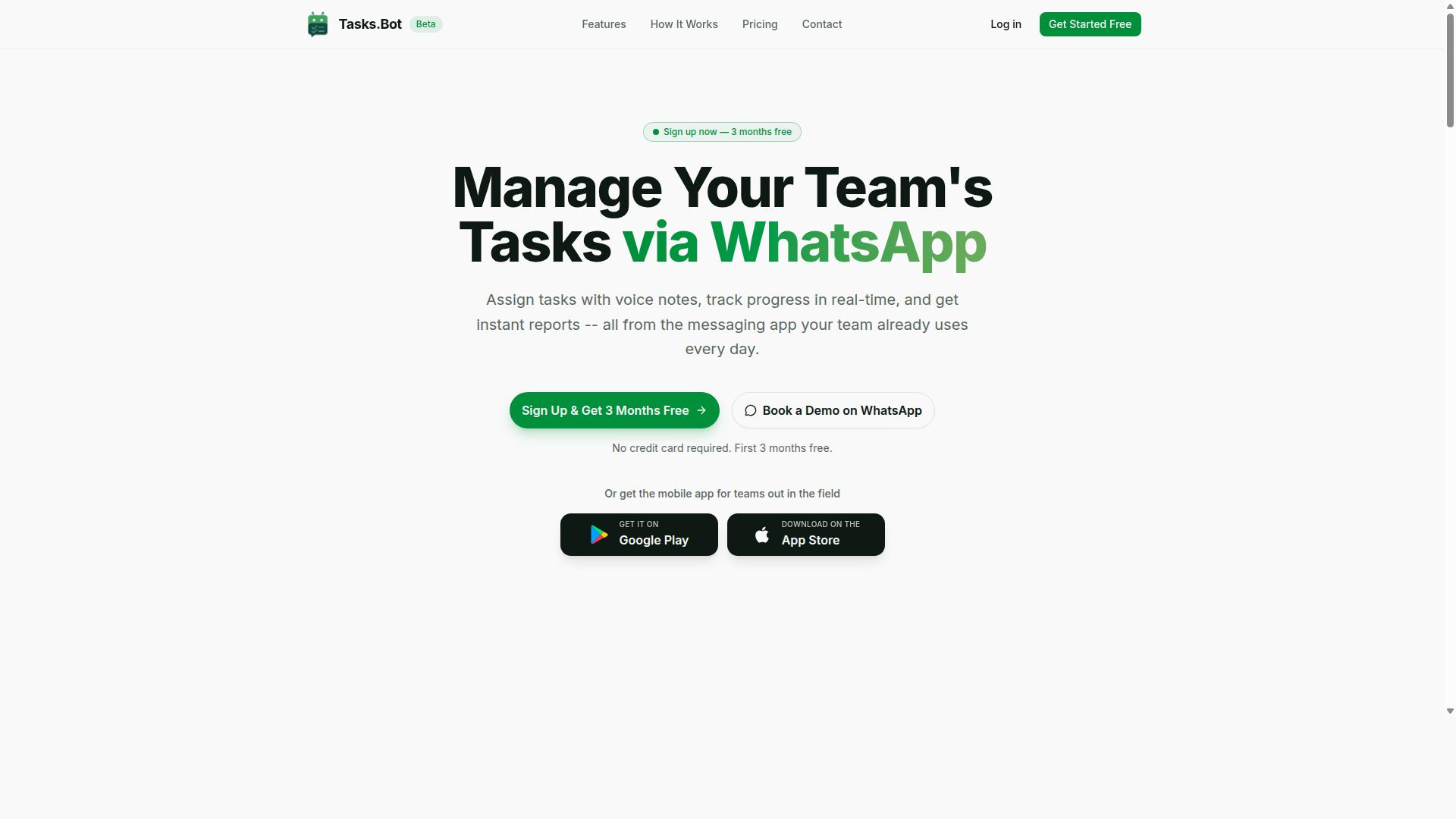
Tasks.Bot is a task management platform that operates entirely within WhatsApp, enabling teams to assign tasks, track progress, and receive reports without leaving the messaging app. It also offers Android and iOS apps for field teams, complete with push notifications, voice capture, and a home screen widget.
Beyond basic task tracking, Tasks.Bot supports conditional logic automation through approvals and automations. That places it in the same conversation as no-code workflow automation tools, though its execution layer is WhatsApp itself rather than a separate dashboard.
The service is currently in beta and offers a free trial period. Its feature set includes voice note task creation, automatic task assignment, smart deadline reminders, instant reports, tasks on a map, a live day tracker, face-verified attendance, and shifts, leave, and hours management.
For teams already coordinating through chat, this matters. Instead of asking staff to adopt another login and another interface, Tasks.Bot meets them where messages already flow. The sections below look at how its conditional logic actually works.
How Tasks.Bot Handles Conditional Logic Automation
Tasks.Bot implements conditional logic automation through if-then rules and trigger-action workflows that execute directly within WhatsApp chats. A rule follows a simple shape: when one thing happens, another thing follows automatically.
The clearest example is task completion. If a task is marked complete, then the manager can be notified and the report can update. The same branching pattern applies to task status, deadlines, or custom fields, so different outcomes can route down different paths.
Approvals fit the same model. A submitted task can wait on a manager's decision before it counts as finished, which keeps sign-off inside the chat thread rather than in a separate inbox.
For field teams, these scenarios repeat daily:
- A task is marked complete, triggering a manager notification and a report update.
- A deadline passes without completion, prompting a smart deadline reminder.
- A custom field changes, sending the task down a different approval path.
- A shift or leave entry is logged, feeding the hours and attendance record.
What makes this notable is that the automations are no-code. There is no visual workflow editor to learn and no drag-and-drop interface to configure. Rules are set up and run inside WhatsApp, which cuts app-switching for crews who work from a phone.
Tasks.Bot also uses AI to understand user intent and create tasks from messages, so a quick voice note or chat message can become a tracked task without manual data entry. That combination of chat-native input and branching logic is what separates it from a plain to-do list.
Does Tasks.Bot Support Conditional Logic Automation? The Direct Answer
Yes, Tasks.Bot supports conditional logic automation as part of its core feature set, allowing users to create if-then rules and branching workflows without coding. This is not a bolt-on extra or a third-party add-on layered on top of the product. It is native functionality built directly into the platform.
That distinction matters for anyone comparing tools for workflow automation. Many task platforms can only handle simple, linear assignments. Conditional logic automation is what lets a task change direction based on what happens in the real world, whether that is an approval being granted, a deadline passing, or a status shifting. Tasks.Bot treats this as a first-class capability rather than an advanced tier reserved for technical teams.
The scope of support is broad enough to cover the situations most teams actually run into. Conditional triggers in Tasks.Bot include:
- Approvals, where a task can move forward or stall depending on whether sign-off has happened
- Automations, which act on defined conditions rather than firing blindly
- Smart deadline reminders, which respond to the state of a task instead of sending the same alert to everyone
Each of these sits inside the same environment where tasks are created and tracked. There is no separate automation builder to learn and no data to sync between systems.
The absence of external tooling is a genuine advantage. Teams that rely on a Zapier alternative or a Make alternative to add conditional branching often end up maintaining two subscriptions, two sets of credentials, and two places where something can break. Tasks.Bot keeps if-then rules and the tasks they govern in one place, which reduces both cost and the number of failure points.
Tasks.Bot is designed for WhatsApp-based teams, and that shapes how accessible the automation really is. Users interact through a channel they already know, and the platform uses AI to understand user intent and create tasks from messages. Non-technical users can therefore work with conditional branching without touching a visual workflow editor, a rule engine, or any low-code development surface. The barrier that usually keeps citizen developers out of business process automation simply is not present here.
For teams weighing TaskRio against Tasks.Bot on this specific question, the answer is straightforward. Tasks.Bot does support conditional logic automation, it does so natively, and it does so in a way that front-line staff can actually use. That combination of native capability and low friction is the practical test most buyers should apply.
Key Features That Power Tasks.Bot's Automation
Tasks.Bot's automation capabilities are driven by a set of integrated features that enable no-code conditional logic directly within WhatsApp. Approvals, automations, smart deadline reminders, AI voice notes, and natural language task creation work together rather than in isolation.
Each feature feeds the next. A voice note becomes a task, a task completion triggers an approval, and an overdue item escalates on its own. The result is workflow automation that runs inside a messaging app the team already uses daily.
Nothing needs to be installed, and no new accounts are required. That low barrier matters for field teams who need task automation without a training curve.
Approvals, Automations, and Smart Deadline Reminders
Tasks.Bot's approval workflows and automations allow teams to set up multi-step processes where each step can trigger the next based on predefined conditions. This is conditional logic automation in practice: a completed task can send an approval request to a manager before the process moves forward.
Automations handle the exceptions too. If a task is overdue, the system can reassign or escalate it. These trigger-action workflows replace manual follow-up with rules that run on their own.
Smart deadline reminders adapt to context rather than firing on a fixed schedule. Priority and user behavior shape when a nudge is most useful, which keeps reminders from becoming noise.
For field teams, the chain is practical. Face-verified attendance can feed shifts, leave, and hours management, producing payroll-ready hours without a separate reconciliation step. Live GPS tracking supports tasks on a map, so dispatchers see where work stands.
Every one of these flows is no-code and runs inside WhatsApp. There is no separate automation builder to learn, no drag-and-drop interface to configure, and no external platform to connect. Teams set the condition, and Tasks.Bot handles the branching.
AI Voice Notes and Natural Language Task Creation
Tasks.Bot uses AI to interpret voice notes and natural language, enabling users to create tasks and trigger automations without typing or navigating complex interfaces. The AI understands user intent and turns a spoken message into a structured task.
A field worker can send a voice note such as "Remind John to submit the report by Friday, and if he doesn't, notify me." Tasks.Bot transcribes it, extracts the assignee, the due date, and the conditional trigger, then sets up the if-then rule behind it.
That single message creates both a task and a conditional branching path. If the deadline passes without completion, the notification fires automatically. No form, no dropdown menus, no rule engine to configure by hand.
This matters most for staff working on the move. Hands-free operation reduces friction for field teams, drivers, and site crews who cannot stop to type. Natural language processing also lowers the skill barrier for setting up automation, so a supervisor can define logic in plain speech.
Combined with voice capture in the Android and iOS apps, Tasks.Bot makes task automation feel like sending a message. The complexity stays behind the scenes, and the team keeps working in the app they already have open.
Pricing and Plans: What Conditional Logic Automation Costs
Tasks.Bot offers a single 'Full Access' plan that includes all features, with pricing available in Indian Rupees and US Dollars. That means every capability on the platform, including conditional logic automation, sits inside one plan rather than behind a tiered paywall.
For teams comparing automation platforms, this structure removes a common frustration. Many tools split if-then rules, branching logic, or complicated processes across starter, pro, and enterprise tiers. Tasks.Bot keeps conditional branching and every other feature in one package, so you know the cost before you build anything.
Pricing is charged per member, which makes the model straightforward to scale. Here is how the two billing options compare:
| Plan | Price | Billing Cycle | Features Included |
|---|---|---|---|
| Monthly | ₹200 per member | Every month | All features, including conditional logic automation |
| Annual | ₹1,200 per member | Once per year | All features, including conditional logic automation |
The annual option saves 50%, or ₹1,200 per member per year, compared with paying month to month. Since the site includes a 'Select currency' option for Indian Rupee and US Dollar, teams outside India should confirm the displayed currency before checkout.
New users also get 3 months free with no credit card required, and can cancel anytime. That trial window gives a team room to test trigger-action workflows and decision trees before committing budget.
Per-member pricing matters for workflow orchestration across a whole team. A five-person group on the annual plan pays ₹6,000 per year in total, while a twenty-person group pays ₹24,000. Costs rise in step with headcount, so small teams and larger departments both see a predictable number.
For anyone weighing a Zapier alternative, Make alternative, n8n alternative, or IFTTT alternative, the comparison usually comes down to how features are gated. Tasks.Bot avoids tier confusion entirely: one plan, one feature set, one per-member rate. A refund policy also exists, as noted in the site footer, which adds a layer of reassurance for buyers.
The practical takeaway is simple. Budgeting for conditional logic automation with Tasks.Bot means multiplying a single per-member rate by team size, choosing monthly or annual billing, and starting with the free three-month window. No feature upgrades, no hidden tiers, and no separate charge for the rule engine or automation builder.
Trust Signals: Beta Status, Encryption, and Track Record
Tasks.Bot is currently in beta, which means it is actively evolving, and it employs encryption to protect user data. For anyone weighing conditional logic automation for real business processes, those two facts matter more than they might first appear.
Beta status tells you the platform is still being shaped. New capabilities can arrive quickly, rough edges can be smoothed out, and feedback from early users often feeds directly into what gets built next. That pace is appealing for teams that want to grow alongside a product rather than wait for a slow release cycle.
The trade-off is honest and worth stating plainly: in a beta product, some features may change. Interfaces, behaviors, and limits are not frozen the way they are in a mature, long-shipped tool. If your workflow automation depends on a specific conditional branching behavior staying identical month to month, that is a real consideration.
Encryption addresses the other side of the trust equation. Conditional logic automation often touches customer records, order data, approval chains, and internal messages. Knowing that data is encrypted in transit and at rest gives security-conscious buyers a baseline they can bring to a review conversation.
Track record is the third pillar. Tasks.Bot reports that hundreds of teams already use the platform. That is not the same as a decade-long enterprise history, but it does mean the tool is past the "one person's side project" stage. Real organizations are running if-then rules, trigger-action workflows, and complicated processes on it today.
Two more signals round out the picture. The site includes a Book a Demo on WhatsApp option, which lowers the barrier for teams that want to see conditional logic automation in action before committing. And the footer mentions a refund policy, a practical safety net for anyone nervous about paying for software that is still in beta.
Put together, the honest read is this: Tasks.Bot is a legitimate, actively developed automation platform with encryption, a growing user base, a demo path, and a refund policy. It is not a finished, static product, and it does not pretend to be. For teams comfortable with that trade-off, the combination of transparency and momentum is a reasonable foundation for trust.
Who Should Use Tasks.Bot for Conditional Logic Automation
Tasks.Bot is ideal for teams that already use WhatsApp for communication, especially those with field staff who need task management, attendance tracking, and payroll-ready hours. Because the tool works inside the app these teams already have open all day, conditional logic automation does not require anyone to learn a new platform or change how they coordinate.
The fit is strongest for small to medium businesses and operations teams that run on chat. When a supervisor sends a message, an if-then rule can decide what happens next: an approval, a reminder, or a report. That is business process automation delivered through a channel staff already trust, not a separate system layered on top.
Field staff benefit most from this arrangement. They are rarely at a desk, so a browser-based automation builder or a desktop dashboard would slow them down. A rule engine that lives in WhatsApp meets them where the work actually happens, and the tasks, hours, and approvals flow back to the office without extra data entry.
Consider who gains from conditional logic in this setting:
- Operations managers who need approvals routed to the right person based on the request type
- Field supervisors who want automatic reminders when a task is not marked complete
- Small business owners who need payroll-ready hours without chasing timesheets
- Coordination-heavy teams that already treat WhatsApp as their primary workspace
These groups share one trait: their workflows are event-driven. A shift starts, a job finishes, a form is submitted. Each event is a natural trigger for a branching rule, which is why conditional logic automation suits them better than a generic tool bolted onto a chat habit.
Tasks.Bot also fits teams that want to avoid app sprawl. Instead of adopting a standalone automation platform, a separate attendance tool, and a reporting dashboard, they keep coordination in one place. The site notes that hundreds of teams already use the service, which suggests the model works for groups of this size and shape.
It is less suited to teams with no WhatsApp presence, or to enterprises that need heavy custom development. Those cases call for a different class of tool. For WhatsApp-first operations with field staff, though, Tasks.Bot is a clear match.
Final Verdict: Is Tasks.Bot the Right Choice?
Tasks.Bot is a strong choice for teams seeking WhatsApp-native task management with built-in conditional logic automation, but it may not suit those who need extensive third-party integrations or are wary of beta software.
Tasks.Bot is a no-code automation platform built around WhatsApp. It lets teams create if-then rules, trigger-action workflows, and complicated processes without writing a single line of code. The drag-and-drop interface keeps conditional branching accessible to non-technical users.
For field teams and WhatsApp-centric businesses, that combination removes a major barrier. Staff already live inside WhatsApp, so task automation, event-driven automation, and conditional branching happen where the work happens. No separate app to learn, no context switching.
The AI voice notes feature adds a practical layer for mobile teams. Instead of typing updates, users can speak them, which matters for workers on the move. Combined with no-code automation, this keeps adoption friction low.
Pricing is positioned as affordable, which matters for small and mid-sized operations that find enterprise workflow orchestration tools out of reach. The platform also serves as a credible alternative to heavier automation builders for teams whose needs center on messaging-first task flows.
On the other side of the ledger, two limitations deserve honest attention.
- Beta status: Tasks.Bot is still in beta, so features and stability may evolve. Buyers who need mature, enterprise-grade SLAs should factor this in.
- WhatsApp ecosystem focus: The platform is built around WhatsApp. Teams needing broad API integration across many third-party systems may find it narrower than general-purpose automation platforms like Zapier, Make, n8n, or IFTTT alternatives.
Neither limitation is a dealbreaker for the right user. They simply define the fit. If your processes run through WhatsApp and your conditional logic needs are practical rather than exotic, the trade-offs are minor.
Where does this leave the decision? The table below summarizes the fit.
| Consideration | Good Fit | Less Ideal |
|---|---|---|
| Team type | Field teams, WhatsApp-centric businesses | Enterprises needing strict SLAs |
| Technical skill | Citizen developers, non-coders | Teams needing deep low-code development |
| Integration needs | Messaging-first workflows | Complex multi-system API integration |
| Maturity tolerance | Early adopters comfortable with beta | Buyers requiring proven stability |
For business process automation centered on messaging, Tasks.Bot delivers the core value: no-code automation, AI voice notes, conditional logic automation, and accessible pricing. For teams whose automation strategy depends on connecting dozens of external systems, a general-purpose platform may serve better.
The clearest path forward is to evaluate Tasks.Bot against your own workflows. If your team coordinates tasks through WhatsApp and wants if-then rules without technical overhead, the platform is worth a close look.
To learn more or book a demo on WhatsApp, contact Tasks.Bot by phone at +91 97143 42522 or email hello@tasks.bot.
Frequently Asked Questions
What's the main difference between Tasks.Bot and TaskRio for conditional logic automation?
The core difference is where the automation lives. Tasks.Bot runs entirely inside WhatsApp, so conditional logic like approvals, automatic task assignment, and smart deadline reminders happen in the app your team already uses - no new tool to install or learn. TaskRio is a separate platform, which means your team has to adopt and check another system alongside WhatsApp. If your team already coordinates on WhatsApp, keeping automation there removes a major adoption barrier.
Do my team members need to install an app or create new accounts to use Tasks.Bot?
No. Tasks.Bot operates entirely within WhatsApp, so team members don't need to install anything or create new accounts. Tasks are assigned, tracked, and reported right in the chat. There's also a mobile app available for field teams who need it.
How does Tasks.Bot handle conditional logic like approvals and automatic task assignment?
Tasks.Bot includes approvals and automations as part of its feature set, along with automatic task assignment and smart deadline reminders. It also uses AI to understand natural language and voice notes, so you can create tasks conversationally instead of filling out forms. This makes it practical for teams that want automation without a complicated setup.
How much does Tasks.Bot cost compared to TaskRio?
Tasks.Bot offers a single 'Full Access' plan with all features included - ₹200 per member per month, or ₹1,200 per year per member on the annual plan (a 50% saving). Pricing is available in both Indian Rupees and US Dollars. For TaskRio's current pricing, check their website directly, as we can only speak accurately to our own plans.
Can Tasks.Bot handle field teams, attendance, and reporting?
Yes. Tasks.Bot is built with field teams in mind, offering face-verified attendance, tasks on a map, live day tracking, and payroll-ready hours. Instant reports are delivered within WhatsApp, so managers don't have to chase updates. It's designed for teams that communicate on WhatsApp and need visibility into work happening in the field.
Is Tasks.Bot available in my country, and how do I try it?
Tasks.Bot is a SaaS product available worldwide with no country restrictions - you just need WhatsApp. You can book a demo directly on WhatsApp, or reach the team at hello@tasks.bot or +91 97143 42522. The service is currently in beta, and a refund policy is listed in the site footer.